Boston Public Library
The Worcester Spy
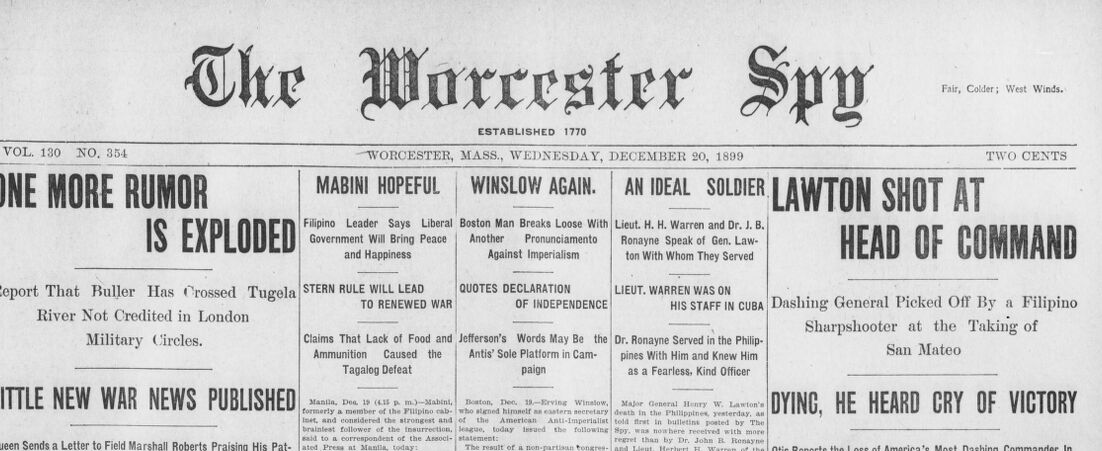
Detail from:
The Worcester Spy. December 20, 1899
The Daily Spy was published in Worcester, Massachusetts from July 24, 1845 until May 31, 1904. It was the second daily newspaper in Worcester, preceded by the Worcester Daily Transcript. On September 30, 1850, the title was changed from Daily Spy to the Worcester Daily Spy, which it kept until 1888. In 1878 the Daily Spy absorbed the Worcester Daily Press, including all subscribers to both the daily and weekly publications. The paper went on to change titles again several times; from 1888-1898 it was known as Worcester Morning Daily Spy, and from 1898 until the publication’s end it went simply by the Worcester Spy.
The Daily Spy proclaimed itself to be a well-rounded paper. An article in the August 4, 1845, publication states, "Our readers will perceive that we intend to make our Daily, a useful family paper, adapted to general circulations, as well in the country as in the town. In addition to a great amount of miscellany and business matter, it will probably contain as much, if not more, agricultural, and scientific reading, as can be obtained from any other source for the money that this paper costs." Shortly after this, on August 9, 1845, the Daily Spy published a response to a local competitor, the Worcester County Gazette after they stated that Worcester had enough political newspapers and needed more with a neutral standing. The Daily Spy refuted this claim, proclaiming its desire was to "look to the welfare of the commonwealth," and that the Daily Spy would be akin to the "eye of Argus," an ancient Greek god with a thousand eyes who kept watch with constant vigilance.
This diligence may have been due to the Daily Spy being born out of the well-known weekly newspaper the Massachusetts Spy. According to Journalism in the United States, from 1690 to 1872, Worcester had the means to support both a weekly and a daily newspaper based on the city's size and commercial interests. However, local merchants objected to a daily paper out of a fear that the cost of advertising would increase. These concerns were addressed by the publishers by inserting advertisements from the weekly version for free into the Daily Spy. Customers soon began inquiring about the articles in the daily versus the weekly, and quickly "cared much less for the weekly than for the daily." In the end the Daily Spy overtook the weekly in both popularity and influence.
Both newspapers were published out of the same office and by the same editor and proprietor, John Milton Earle. Earle was a prominent member of society, held public offices, and was appointed postmaster of Worcester in 1862 and reappointed in 1865. He was credited, according to the National Cyclopaedia of American Biography, as continually being "on the right side of every moral issue before the public." He was a well-known early proponent of the anti-slavery Republican party, and because of his work with both the Daily Spy and its weekly counterpart, "made Worcester the banner county of the state in opposition to slavery."
On May 21, 1902, a disastrous fire broke out in the building of the Daily Spy. No one was injured but "the entire plant of the Spy was practically destroyed," according to an article in the Boston Daily Globe. After the fire, the owner of the newspaper at the time, Mr. Charles Nutt, tried to keep the Spy going. Unfortunately, two years later publication was permanently suspended. The Worcester Spy published its final issue on May 31, 1904, with no explanation for its closure provided within the text.
The Daily Spy proclaimed itself to be a well-rounded paper. An article in the August 4, 1845, publication states, "Our readers will perceive that we intend to make our Daily, a useful family paper, adapted to general circulations, as well in the country as in the town. In addition to a great amount of miscellany and business matter, it will probably contain as much, if not more, agricultural, and scientific reading, as can be obtained from any other source for the money that this paper costs." Shortly after this, on August 9, 1845, the Daily Spy published a response to a local competitor, the Worcester County Gazette after they stated that Worcester had enough political newspapers and needed more with a neutral standing. The Daily Spy refuted this claim, proclaiming its desire was to "look to the welfare of the commonwealth," and that the Daily Spy would be akin to the "eye of Argus," an ancient Greek god with a thousand eyes who kept watch with constant vigilance.
This diligence may have been due to the Daily Spy being born out of the well-known weekly newspaper the Massachusetts Spy. According to Journalism in the United States, from 1690 to 1872, Worcester had the means to support both a weekly and a daily newspaper based on the city's size and commercial interests. However, local merchants objected to a daily paper out of a fear that the cost of advertising would increase. These concerns were addressed by the publishers by inserting advertisements from the weekly version for free into the Daily Spy. Customers soon began inquiring about the articles in the daily versus the weekly, and quickly "cared much less for the weekly than for the daily." In the end the Daily Spy overtook the weekly in both popularity and influence.
Both newspapers were published out of the same office and by the same editor and proprietor, John Milton Earle. Earle was a prominent member of society, held public offices, and was appointed postmaster of Worcester in 1862 and reappointed in 1865. He was credited, according to the National Cyclopaedia of American Biography, as continually being "on the right side of every moral issue before the public." He was a well-known early proponent of the anti-slavery Republican party, and because of his work with both the Daily Spy and its weekly counterpart, "made Worcester the banner county of the state in opposition to slavery."
On May 21, 1902, a disastrous fire broke out in the building of the Daily Spy. No one was injured but "the entire plant of the Spy was practically destroyed," according to an article in the Boston Daily Globe. After the fire, the owner of the newspaper at the time, Mr. Charles Nutt, tried to keep the Spy going. Unfortunately, two years later publication was permanently suspended. The Worcester Spy published its final issue on May 31, 1904, with no explanation for its closure provided within the text.