Boston Public Library
Francisco de Goya (1746-1828). Prints Collection

Detail from:
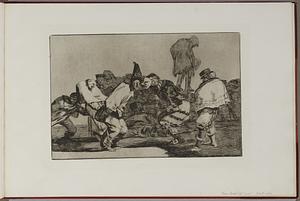
Lluvia de toros = Pluie de taureaux
Francisco de Goya was a Spanish artist, painter, and printmaker. Born to a middle-class family in Fuendetodos in 1746 and raised in Zaragoza in the Aragon region of Spain, Goya began his studies as an artist at 14 under José Martínez Luzán, later studying in Madrid and Rome before returning to Zaragoza. In Zaragoza, Goya married Josefa Bayeu in 1773. Josefa's brother Francisco Bayeu helped Goya secure work designing tapestries at the Royal Tapestry Factory of Santa Barbara in Madrid from 1775 until 1780 and in 1782 through 1792. Early in his time in Madrid, Goya used his access to the royal collections to make etchings after paintings by Diego Velázquez.
As Goya's work became known in Madrid, he began to receive commissions from the nobility. Goya was named court painter to Charles IV in 1789. After a debilitating illness in the early 1790s, Goya lost his hearing, and spent some time away from court to recover his health. Goya returned to Madrid where he remained the court painter after this and other periods of illness and through the abdication of Charles IV, the ascension and then dispossession of Ferdinand VII, the installation of and popular uprising against Joseph Bonaparte, the Peninsular War, and the eventual restoration of Ferdinand VII. After the restoration of the monarchy in 1814, Goya went into seclusion and later into exile in France. He died in Bordeaux France in 1828.
Prints by Francisco Goya have been part of the collections of the Boston Public Library since the 1941 gift of Albert H. Wiggin establishing the Print Department, which included complete early editions of the Tauromaquia and Proverbios, as well as two lithographs from the series The Bulls of Bordeaux. In 1947, the library purchased first edition sets of the Caprichos and Desastres de la Guerra. Later gifts and purchases brought the holdings by Goya to their current extent of over 200 works.
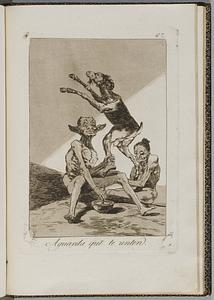
Goya's Caprichos were first published in 1799. This group of 80 aquatints with etching take on corruption, superstition, vice, and prejudice in a critique of the royal court and the society in which Goya lived. Goya withdrew the Caprichos from sale for political reasons before many were sold. Later in life, Goya indicated these prints had brought him to the attention of the Inquisition, a situation to be avoided if possible, and one that Goya escaped by gifting the copper plates and unsold prints to the crown.
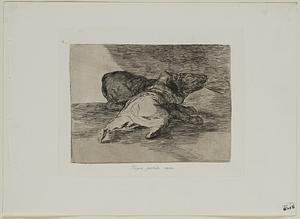
The series Los Desastres de la Guerra was created by Goya between 1810 and 1820 in response to the Peninsular War, which began with a popular uprising against Napoleon Bonaparte's 1808 installation of his brother Joseph as the King of Spain. These 80 plates in aquatint and etching depict the atrocities of war and the impact of those atrocities, falling into three broad groups: war, famine, and allegorical scenes critiquing the political environment during and immediately after the war. Preliminary drawings and the etching of the plates were completed during the war, but the series was not published until 1863 -- 35 years after Goya's death -- when changes in the political atmosphere made their circulation possible.
The series La Tauromaquia was created between 1815 and 1816 and published in 1816. This set of 33 prints is done in aquatint and etching and depicts men hunting, fighting, and killing bulls for sport and spectacle. Unlike Goya's earlier sets of prints, La Tauromaquia was published without complications.
The Proverbios, also known as Los Disparates or Sueños were created between 1815 and 1823, but not published until 1864. Goya left his country home outside Madrid for exile in Bordeaux, France in 1824, and left this series of plates behind in Spain, unfinished. These prints are in etching and aquatint, with touches of drypoint and engraving, depicting dark and dream-like scenes. Originally published as a set of 18, as in this set, some editions include an additional four prints to make sets of 22.
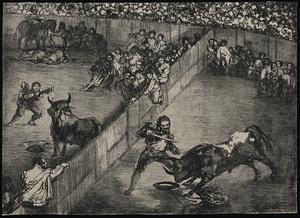
In The Bulls of Bordeaux, Goya returned to the subject of bullfighting. Living in exile in France, Goya learned the relatively new technique of lithography. He worked with printer Cyprien Gaulon to produce the set of four prints originally published as Courses de taureaux in 1825.
As Goya's work became known in Madrid, he began to receive commissions from the nobility. Goya was named court painter to Charles IV in 1789. After a debilitating illness in the early 1790s, Goya lost his hearing, and spent some time away from court to recover his health. Goya returned to Madrid where he remained the court painter after this and other periods of illness and through the abdication of Charles IV, the ascension and then dispossession of Ferdinand VII, the installation of and popular uprising against Joseph Bonaparte, the Peninsular War, and the eventual restoration of Ferdinand VII. After the restoration of the monarchy in 1814, Goya went into seclusion and later into exile in France. He died in Bordeaux France in 1828.
Prints by Francisco Goya have been part of the collections of the Boston Public Library since the 1941 gift of Albert H. Wiggin establishing the Print Department, which included complete early editions of the Tauromaquia and Proverbios, as well as two lithographs from the series The Bulls of Bordeaux. In 1947, the library purchased first edition sets of the Caprichos and Desastres de la Guerra. Later gifts and purchases brought the holdings by Goya to their current extent of over 200 works.
Goya's Caprichos were first published in 1799. This group of 80 aquatints with etching take on corruption, superstition, vice, and prejudice in a critique of the royal court and the society in which Goya lived. Goya withdrew the Caprichos from sale for political reasons before many were sold. Later in life, Goya indicated these prints had brought him to the attention of the Inquisition, a situation to be avoided if possible, and one that Goya escaped by gifting the copper plates and unsold prints to the crown.
The series Los Desastres de la Guerra was created by Goya between 1810 and 1820 in response to the Peninsular War, which began with a popular uprising against Napoleon Bonaparte's 1808 installation of his brother Joseph as the King of Spain. These 80 plates in aquatint and etching depict the atrocities of war and the impact of those atrocities, falling into three broad groups: war, famine, and allegorical scenes critiquing the political environment during and immediately after the war. Preliminary drawings and the etching of the plates were completed during the war, but the series was not published until 1863 -- 35 years after Goya's death -- when changes in the political atmosphere made their circulation possible.
The series La Tauromaquia was created between 1815 and 1816 and published in 1816. This set of 33 prints is done in aquatint and etching and depicts men hunting, fighting, and killing bulls for sport and spectacle. Unlike Goya's earlier sets of prints, La Tauromaquia was published without complications.
The Proverbios, also known as Los Disparates or Sueños were created between 1815 and 1823, but not published until 1864. Goya left his country home outside Madrid for exile in Bordeaux, France in 1824, and left this series of plates behind in Spain, unfinished. These prints are in etching and aquatint, with touches of drypoint and engraving, depicting dark and dream-like scenes. Originally published as a set of 18, as in this set, some editions include an additional four prints to make sets of 22.
In The Bulls of Bordeaux, Goya returned to the subject of bullfighting. Living in exile in France, Goya learned the relatively new technique of lithography. He worked with printer Cyprien Gaulon to produce the set of four prints originally published as Courses de taureaux in 1825.