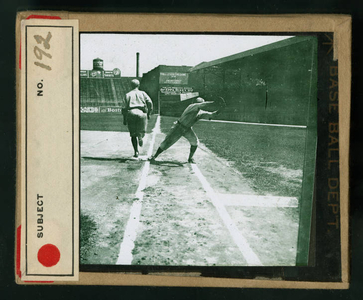
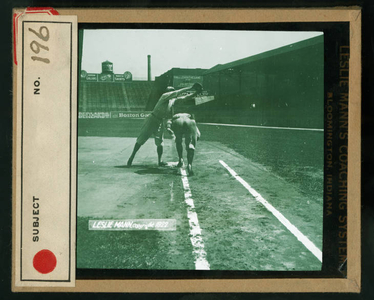
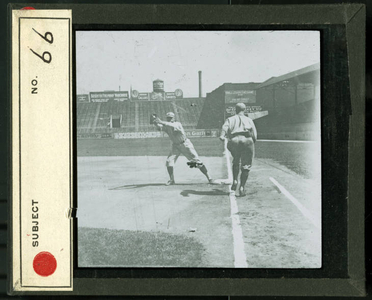
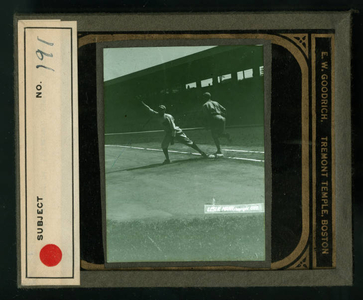
Leslie Mann Baseball Lantern Slide, No. 68
Item Information
- Title:
- Leslie Mann Baseball Lantern Slide, No. 68
- Description:
-
Jake Daubert, a first baseman for the Cincinnati Reds, has successfully rounded first base. His left foot is tagging first base in the image, and based on Daubert's position and body language as he looks forward, it appears that Daubert will attempt to run to second base. The first baseman, who appears to be a member of the St. Louis Cardinals, gazes into the outfield, most likely looking in the direction that Daubert has hit the baseball.
- Creator:
- Mann, Leslie
- Format:
-
Photographs
- Location:
- Springfield College Archives and Special Collections
- Collection (local):
-
Leslie Mann Baseball Lantern Slide Collection
- Subjects:
-
Baseball
Baseball fields
Baseball caps
Daubert, Jacob Ellsworth
Cincinnati Reds
Base Running
Crosley Field, Cincinnati, Ohio
- Link to Item:
- https://cdm16122.contentdm.oclc.org/cdm/ref/collection/p16122coll10/id/112
- Terms of Use:
-
Rights status not evaluated.
This work is licensed for use under a Creative Commons Attribution Non-Commercial Share Alike License (CC BY-NC-SA).
- Publisher:
-
Springfield College
- Language:
-
English
- Notes:
-
Daubert demonstrates the proper way to step on first base as he steps on the middle of the bag with his left foot. It doesn't matter which foot is used when stepping on the bag. The player should be in their normal running stride as they reach the base and they should naturally step on the base. After stepping on the base, Daubert would continue his natural running stride as he ran towards second base, so it wouldn't make a difference which foot hit the bag. A base runner shouldn't care which foot hits the bag and should use whatever foot naturally makes contact with the base. If the base runner had chosen a preference foot, then this could slow their stride down. For example, here Daubert steps with his left foot on the bag. If Daubert had chosen his preference of his right foot to step on first base, he would have to slow his stride down to ensure that his right foot hit the base, and slowing his stride down would make him take longer to reach second base, which could result in him being thrown out. Therefore, Daubert should run normally and use whatever foot naturally strides over the base to step on first base rather than attempting to pick a specific foot. Daubert's number one priority here is to step on first base, and the best way to do this is by stepping on the middle of the bag as it ensures that the base runner makes contact with the base.
Jacob Ellsworth Daubert was born on April 17, 1884, in Shamokin, Pennsylvania. He started working in the coal mines when he was 11, and was very lucky to have been a talented baseball player because it allowed him to escape from a life of working in these mines, a job that killed one of his brothers. He played semi-professional baseball until 1910, when he was purchased by the Brooklyn Superbas. While playing in Brooklyn, the team experienced three different team names, being the Brooklyn Superbas, the Brooklyn Dodgers, and the Brooklyn Robins. He was traded to the Cincinnati Reds in 1919 over a contract dispute, and remained there until the end of his career. Daubert was an exceptional hitter, as he hit over .300 in 10 seasons, and won 2 batting titles. Daubert also won the MVP Award in 1913, though at the time it was known as the Chalmers Award. Along with his consistent hitting, Daubert was also an exceptional bunter, holding a record for having four sacrifice bunts in a single game. He also led the league twice in triples, and finished his career with 165 of them. Daubert was also one of the best first baseman fielders in his era, as he led the league three times in fielding percentage. Another very interesting fact about Daubert is that he was a very intelligent business man, meaning he didn't need to play baseball to make money, but chose to anyway. In 1924, Daubert was beaned by a pitch, and after the beaning, he experienced headaches and difficulty sleeping. It was eventually discovered that he had a hereditary condition involving his spleen, and Daubert tragically passed away that year at age 40. Though the condition was hereditary, many people believe the beaning may have had an effect on his eventual death. If Daubert had lived today, he probably would have been able to receive proper treatment and medicine and wouldn't have died from his condition. Daubert was not elected to the Baseball Hall of Fame, which is surprising because Daubert seemed to be one of the best players in his time period, and he excelled at every element of the game when he played.
Leslie Mann identifies the baserunner in slide 68 as Jake Daubert on page 21 of his manual titled the Fundamentals of Baseball.
Good condition;
This digital image is made from two separate digital scans; one scan of the lantern slide (reflective); one scan of the image (transparecy); the two images were then combined in Photoshop to create the final image.
Lantern slide from the Leslie Mann baseball instruction course, "The Fundamentals of Baseball"
Sandoval, Jim. "Jake Daubert." Society for American Baseball Research, [ https://sabr.org/bioproj/person/3fca088a ]. Accessed 14 Feb. 2018. ___Internet Archive___. [http://web.archive.org/web/20180214184922/https://sabr.org/bioproj/person/3fca088a].
- Identifier:
-
LANT-BSBL-068-03
068